
This little project about preaching is for two types of people. First, it is for pastors interested in preaching and thinking about these things. Find encouragement in your God-given style and find inspiration in how other faithful pastors go about preaching.
It is also for people who hear a voice, sense a call, and yet do not know how to say yes because preaching seems to be such an uncomfortable, difficult, and tough thing to do. I have been there and done that, and I am here to say, God is faithful and you can do it. The data shows that there are plenty of ways to preach and prepare faithfully.
As a pastor, preaching matters to me. It is one of the more visible things that I do on a regular basis, so it makes sense that I would give thought to the process of preaching God’s word. In that spirit, I was inspired to ask other pastors several questions about their preaching process. The five questions I asked were:
- How much time do you spend on a sermon per week?
- Do you make use of commentaries, Bible dictionaries, and other similar resources?
- Do you manuscript your sermon or do you outline?
- Have you ever reused someone else’s sermon?
- Do you still get nervous before speaking?
Many pastors responded, and I thank every one of them who did. Many gave very detailed answers; some gave brief ones. All of it was helpful and brought great insight. This article is a breakdown of their answers.
Before we get to that breakdown, I want to share a little more about why this matters to me.
A Hero, a Hindrance, and a Yes
I grew up in church. My mother worked — and still works — at the church I grew up in (Dalton Church of God/Cross Pointe Christian Centre). During that time, I had great pastors in my life: a great children’s pastor, great Sunday school teachers, great youth pastors, great senior pastors, and even great associate and music pastors. I feel very blessed, looking back, to recognize the role that all of these great men played in my life and in my development as a Christian — and now as a pastor myself.
Of these pastors, many were competent and perfectly fine at preaching and teaching, some more than others, as is natural. But there is one person in my life who stands above the rest. His name is Pastor Hal Thompson, Junior. There is no other preacher in my life experience who comes close to his consistency, passion, and excellence in preaching the word of God and the gospel.
Every sermon was a masterclass in what God can do through a person. Watching him preach word by word, line by line from Scripture was impressive from a purely worldly perspective — but when combined with his spiritual passion and the presence of the Holy Spirit, those times he preached became engraved in who I am. His style, his cadence, his rhythm are still things I carry with me today.
I remember him preaching through the entire book of Acts and somehow keeping me from getting bored even as a 10-year-old. Later in life, I had a conversation with him and he told me that he often had no ending place picked out for his sermons. He would simply start where he left off last time, and when he felt it was time to stop, he would arrive at a stopping point and a closing. And it almost never failed to land and inspire. Myself, a pastor who uses a manuscript and thinks carefully ahead of time about how I’m going to close, I find that astounding.
I once watched him deliver what I believe was a Christmas message based on the names of God through every book of the Bible — tracing those names to the culmination of the birth of Jesus and beyond — never once looking down at his notes. For someone who needs either a detailed outline or a manuscript in front of him, watching someone do that sticks with you.
And yet — and this is how it sometimes works with the enemy of your soul — there came a hindrance from the blessing. More accurately, I let the blessing of Pastor Thompson’s anointing and skill become a hindrance in my journey to obey God.
As I entered college, I resigned myself to simply being a good church member. Now, there is absolutely nothing wrong with that! It is a holy calling. And yet seemingly every week, there were moments drawing me not just back to church as a faithful member, but toward becoming a pastor and a preacher. I wanted to talk about God. I wanted to help people understand God from the scriptures. I wanted them to be inspired like I had been inspired.
There were several problems with this. The first was that I hate being in front of people. One of my worst college grades came from speech class. I refused to get up and deliver any of my speeches. I prepared all of them and turned in the written portions but refused to stand when my name was called. I was failing until I begged the teacher and explained my deep-seated fear of public speaking.
The other problem: I had decided that if I could not preach like my hero, what was the point? If I can’t play like Michael Jordan, why play at all? Hopefully you see how foolish that is for basketball — and how much more foolish it is for God’s calling on your life.
I still cannot preach like Pastor Thompson, and I still hate — and I mean hate — being in front of people. Yet now I preach every week. I enjoy it despite the dread.
One day during my senior year at Lee University, walking out of the music building, I heard that voice say, “Just say yes.” Of course I knew what the yes was for. And finally, after about five years of saying no and finding excuses, I said yes right there walking to the humanities building.
From that point, things just worked out. I realized preaching could be done. My first sermon was at my younger brother’s funeral. I do not remember anything about it except feeling that the Holy Spirit was carrying me, and if that is all I ever have, that would be more than enough. It is more than enough for you too. Say yes.
Now, onto the Results
Twenty-four pastors answered these five questions. Some responses were brief. Some were paragraphs long. All of them were honest. Here is what they said.
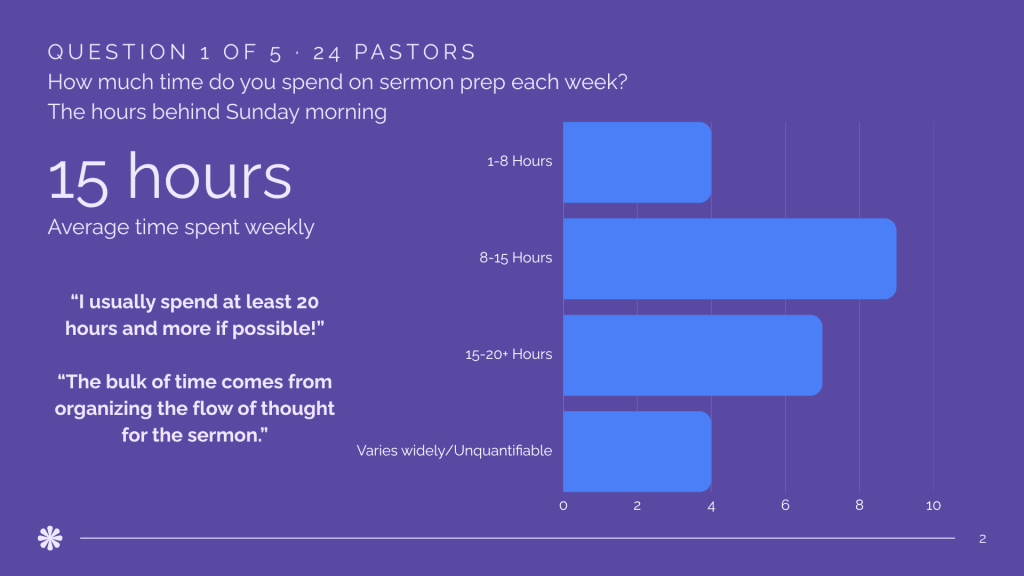
Question 1: How much time do you spend on sermon prep each week?
The range was wider than you might expect — from as little as one hour to 20 or more per week. The most common range was 8 to 15 hours, with several pastors in the 15 to 20+ bracket. A handful resisted the question altogether, pointing out that a lifetime of study and ministry experience can’t be reduced to a weekly clock-in. Context matters too: one pastor spends a single hour on a youth curriculum sermon but 10+ hours on a message he’s traveling to preach.
I try to get close to 10 -15 hours of preparation. Being bi-vocational and having three kids (another on the way) can keep that from happening some weeks. Other weeks I might go to 20 hours, but normally that ends up turning into two sermons.
“I usually spend at least 20 hours and more if possible!”
“The bulk of time comes from organizing the flow of thought for the sermon.“
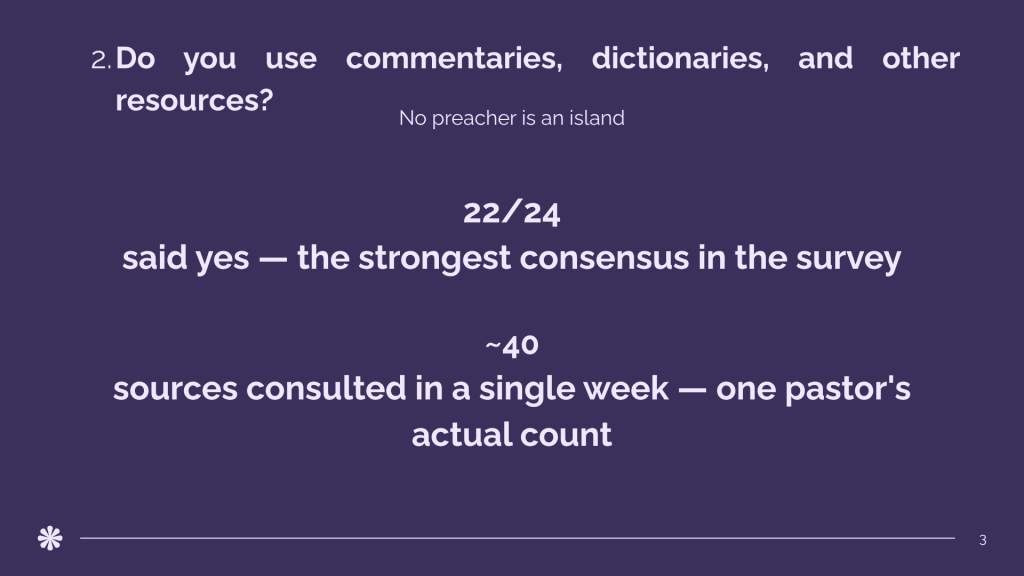
Question 2: Do you use commentaries, Bible dictionaries, and other resources?
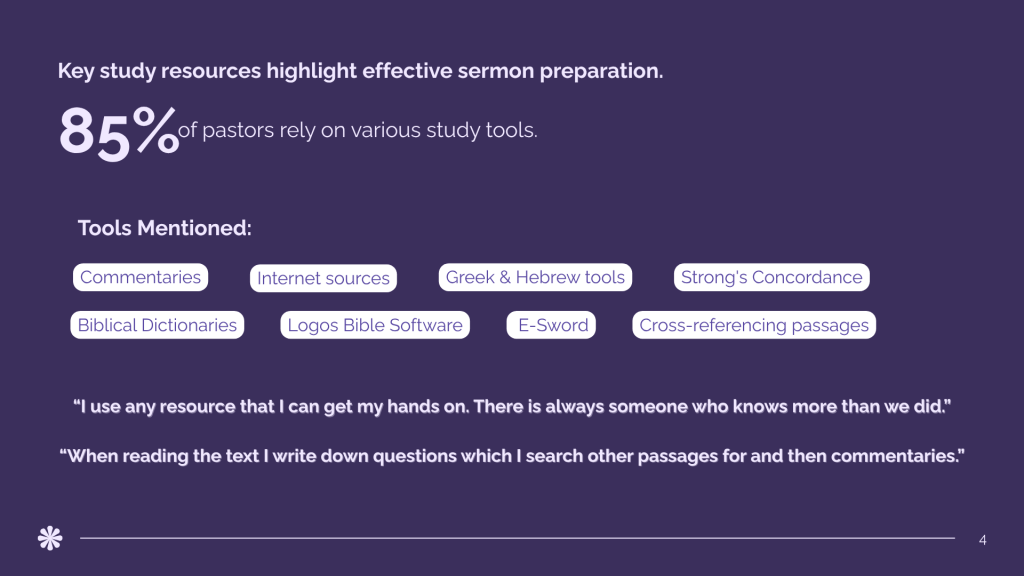
This produced the strongest consensus in the entire survey: 22 out of 24 pastors said yes. Tools ranged from print commentaries and Strong’s Concordance to Logos Bible Software and E-Sword, to Greek and Hebrew language tools and simple cross-referencing of Scripture. One pastor averages roughly 40 sources per week.
I use two to three sources per week outside of the biblical text.
“I use any resource that I can get my hands on. There is always someone who knows more than we did.”
“When reading the text I write down questions which I search other passages for and then commentaries.”
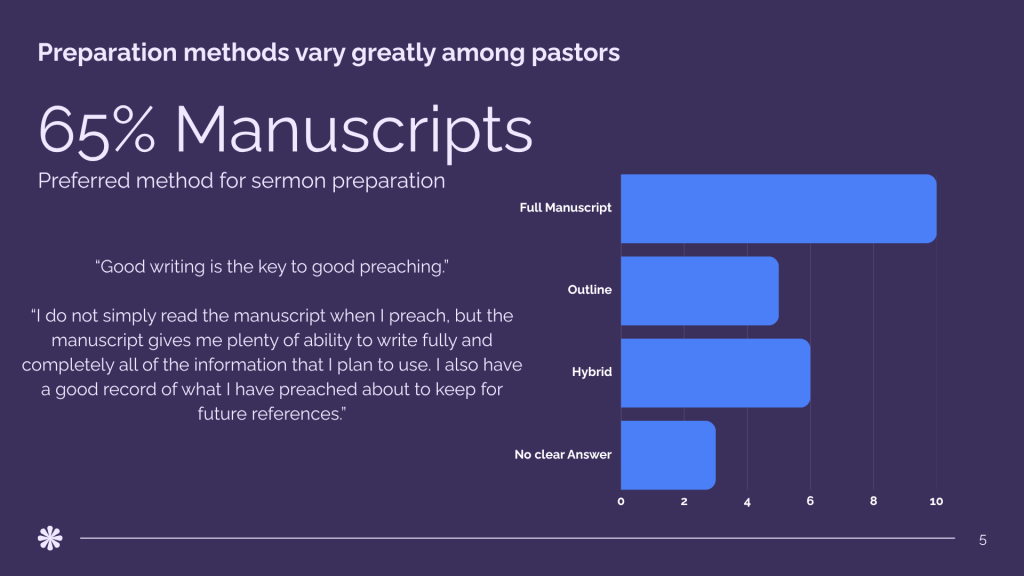
Question 3: Do you manuscript your sermon or outline?
Manuscripting leads at 42%, but the hybrid approach — write a full manuscript for depth, distill to an outline for delivery — was a close second at 25%. Pure outliners make up 21%. The reasons behind each approach are often more revealing than the method itself: some manuscript to remember every point, some to keep a personal archive, some because they believe good writing is inseparable from good preaching.
I manuscript. I like seeing it all together, I like the record of it, and often times my sermon ends up being quite different than what is on the page. It is comforting to have it in front of me.
“Good writing is the key to good preaching.”
“I do not simply read the manuscript when I preach, but the manuscript gives me plenty of ability to write fully and completely all of the information that I plan to use. I also have a good record of what I have preached about to keep for future references.”
Question 4: Have you ever reused someone else’s sermon?
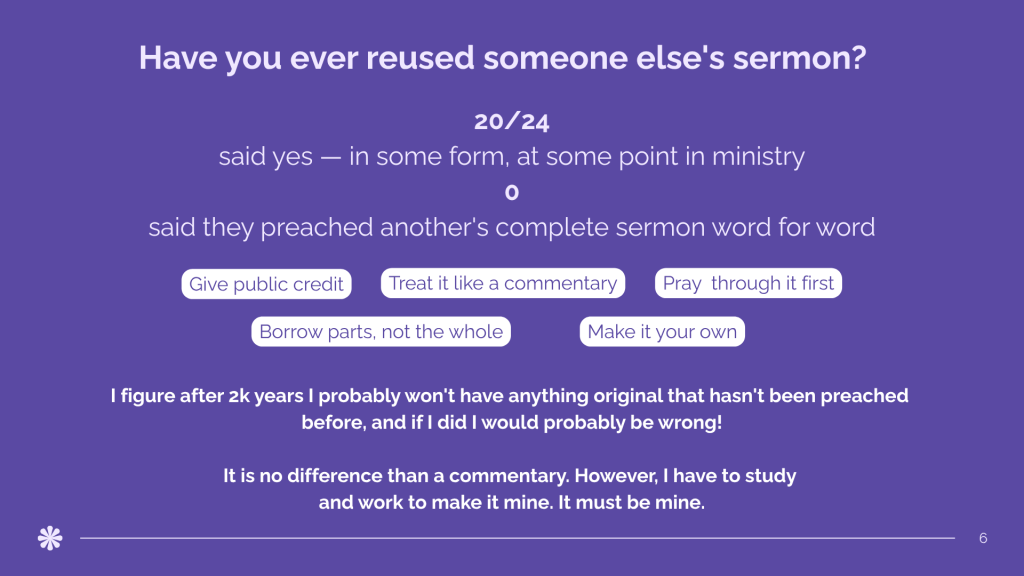
This was the question everyone was curious about but few had ever asked openly. 20 out of 24 pastors said yes, in some form. And notably, not a single pastor said they had preached another person’s sermon word for word without modification. The unwritten rules: give public credit, use it as a starting point, do your own prayer and study, and make it yours before you deliver it.
I have used other people’s material (maybe once or twice a year). I try to give credit when it is heavily pulled from someone else, but I rarely feel the need to do that since the material I pull from almost always changes dramatically from the source. Also, If someone used my sermon word for word, and did not credit me, no big deal. At this point (2,000 years later), we are all most likely repeating someone.
“I figure after 2k years I probably won’t have anything original that hasn’t been preached before, and if I did I would probably be wrong!”
“It is no difference than a commentary. However, I have to study and work to make it mine. It must be mine.”
Question 5: Do you still get nervous before speaking?
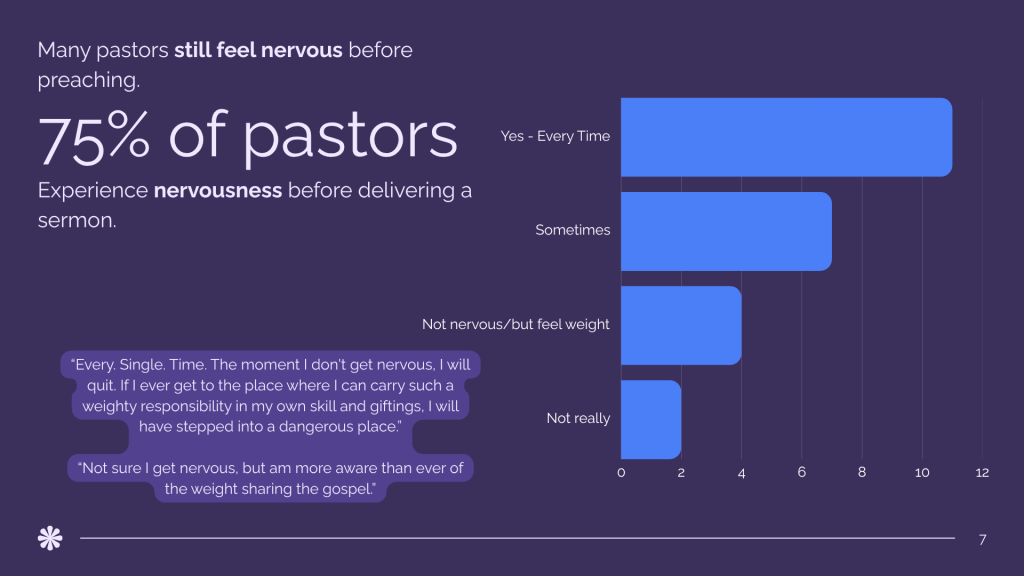
This produced the most theologically rich responses in the survey. 11 of 24 pastors said yes, every single time. Seven said sometimes, or that it depends on the occasion. Four said they don’t get nervous exactly, but are more aware than ever of the weight of what they’re doing. Only two said not really.
For most of these pastors, nervousness is not a weakness — it is a sign of something right. Two pastors made a striking commitment: if they ever stopped being nervous, they would quit.
I think, at this point, my nerves are good. The ground me and humble me.
“Every. Single. Time. The moment I don’t get nervous, I will quit. If I ever get to the place where I can carry such a weighty responsibility in my own skill and giftings, I will have stepped into a dangerous place.”
“Not sure I get nervous, but am more aware than ever of the weight sharing the gospel.”
What the Data Says — and What It Doesn’t
The methods vary widely. The hours vary. The tools vary. Whether you write a full manuscript or a lean outline, whether you study for three hours or thirty, whether you’ve borrowed a sermon or never have — none of that is what makes a preacher. What the data keeps pointing back to is something much simpler: these pastors take it seriously. They show up prepared. They stay humble. And they depend on God.
If you are a pastor reading this, I hope you found encouragement. Your method is yours. God gave it to you. Keep refining it, keep growing, and keep saying yes every week.
And if you are someone who has heard a voice and keeps finding reasons to say no — I hope the data helped. There is no one way to do this. There never was. The only question is whether you will say yes.

 Zachary Peters
Leave a comment