
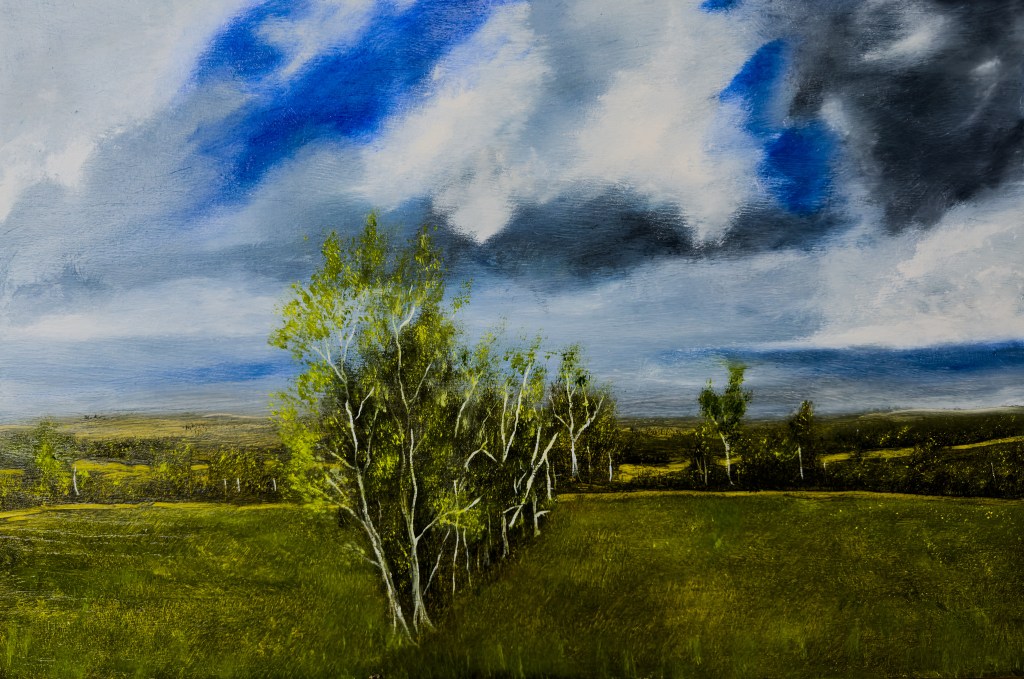
Herschel, with a small smile, watched Jean move around the kitchen, preparing dinner. It looked like she was floating from the stove to the sink to the pantry. Her porcelain-skinned hands, moving this pot, pouring that cup, and sliding that dish, looked elegant and out of place in the old country kitchen. He had not the slightest idea what she was making, but there was the warm smell of bacon, cheese, and fresh bread.
The floorboards creaked with every one of her busy steps. Need a few more nails, he thought. The sun’s rays streamed in from the big single-pane window he and his neighbor Bob had installed just one summer earlier. Jean liked the window with the curtains drawn wide open. She hated a dark room. She would not stop bothering him about the electricity that was supposed to be coming to town in the next year or so. Herschel did not know about all that.
Something knocked into his legs under the kitchen table. He leaned over, peering beneath the tabletop. His little boy was playing with a metal cavalry horse, and the boy had fallen over onto Herschel’s feet. The boy looked up, his sharp blue eyes bright in the shadows. “Sorry, Pa,” he said.
“That’s okay. You like that horse?”
“Yes, sir, I wish I had about five more!” he exclaimed with eager seriousness.
Herschel’s smile, which had never left his face, grew, stretching from ear to ear. The dimple in his cheek expanded from a suggestion of a shadow into a crevice running from his cheekbone down to his jawline.
“What are you smilin’ at over there?” Jean asked, with no small amount of sarcasm.
“Oh, just life,” he answered. He rubbed his son’s hair before leaning back up to look at Jean. She was a small woman. Not so small as to be abnormal, but small enough that from a distance she might be mistaken for a young girl. Her face was soft and round with a smattering of freckles on her nose. Her brown hair fell in curls around her face. She was pleasant to look at, like a green hill beside a mountain. One might prefer the mountain, but he loved the rolling green hills bunched at the foot of the mountain.
He had loved her from the first moment he had seen her walking by the station house in Blue Ridge, Georgia. He had jumped off the still-slowing train to catch her before he lost track of her in the departing crowd from Nashville.
“I’d smile too if someone was cooking me something this good,” she said, smiling.
He stood up and took two big steps toward her. “What else would make you smile?”
She giggled like a child. “Stop that.”
He kissed her, and she kissed him back.
“Let me go, I’m gonna burn the food.”
“Fine.” He loved the way she spoke — that sweet, drawn-out Southern accent. It drew him into every one of her words. “I am going to work on the shed. Give me a yell when you are ready.”
“Okay, honey,” she said, engrossed in cooking again. He walked out the side door of the kitchen.
The cold air pleasantly stung his face as Herschel took his first steps outside. Taking a deep breath, he let the air fill every corner of his lungs. He let it all hiss out in a rush of steam through his smiling mouth. Any cold day reminded him of the countless cold days of his youth up north in the woods outside of Cleveland, OH, where he had grown up and worked until his parents had decided to settle in Cincinnati. He had left as a 17-year-old soon after their move and then traveled across the country and back again, working on the railroads.
He walked to the new shed he had just finished framing. The smell of sawdust was strong even in the cold, and some of the sawdust had frozen in small piles around the sawhorses next to the fledgling building. He uncovered the wood planks he was using for the siding, and in no rush, dragged them over one at a time to the framing of the shed. Hoisting one of the planks up, Herschel hammered one nail in place through the plank into the framing, and then used that one nail as a pivot point as he worked more nails along the span of the board.
After he had leisurely placed and secured four boards on the framing, he heard someone yell, “Don’t ya know some people are trying to nap around here?”
He looked towards the source of the voice and then laughed when he saw his neighbor clambering down his front steps. “Where?” he asked, looking around dramatically. “Surely not someone as busy as yourself, Bob.”
Bob walked over and shook Herschel’s hand. He looked around at the shed and the tools everywhere. “You can’t stay still, can ya, Herschel?”
“No, if the sun is up, there’s got to be something to do,” Herschel said. Nothing worse than downtime, he thought.
“Well, I like my free time, but let me give ya a hand there, Herschel,” Bob said, leaning over to grab one end of another board.
“You don’t have to, Bob,” he said, hoping Bob was serious.
“No, I insist,” Bob said as he lifted the board up and, with Herschel’s help, put it in place on the framing. “No work at the rail yard?”
Herschel, his big hand curled around the hammer, slammed two nails into the end of the board, then tossed the hammer to Bob. “Not until after three. Bad weather up north. Everything is delayed.”
“That’s right, the postman said something about that. Snow in March, how about that?” Bob said, with two nails precariously hanging from his mouth. He took one out of his mouth and hammered it home, and then the other.
“What about you? The Mayor have you running around doing anything interesting?” Herschel asked.
“As a matter of fact, yeah,” he said and offered a curious glance at Herschel. “You read about the old mill that was burnt down?”
“Yeah, a few weeks back. Didn’t read it, but heard about it at church.”
“Well, just so happens the Riddley family opened a mill a week ago.”
“Is that right? That’s good timing,” Herschel said with a wink.
“Everyone at the office thought so too, and now you either have to go all the way up to Pratter’s Mill, or the new Riddley Mill, which is half the distance.” Bob set the hammer down and looked worriedly at Herschel. “That family has been trouble since they got here, but they always manage to know the right person or the right lawyer.”
Herschel pulled a few nails out of his back pocket and mindlessly fidgeted with them in his big hand. “I haven’t had any run-ins with them, but my father-in-law says, ‘Stay away.”
“Good man, and smart. I’d listen to him. No disrespect, but there is a certain specter of ill omen on them.”
“What is that, Shakespeare?” Herschel chuckled.
“What? No, just something about that family is all.”
“What are you going to do about the mill?” Herschel asked, putting the nails back in his pocket.
“Ehh, don’t know yet, but I have my eye on them now,” he said and nodded slowly, with a thin-lipped smile.
They both leaned over to pick up a board, then heard Jean yell from the window, “Lunch is ready!”
Herschel put the board down and called back, “Be there in a minute.” He turned back to Bob and asked, “You want to come in?”
“Oh, no, I got food waiting for me inside. Come knock on my door when you need some help with this thing.”
“Will do, Bob, thanks,” Herschel said, and they shook hands, and both went on their way.
The sun rose to its zenith and then began to falter toward the horizon. Herschel did not know the actual temperature, but he was sure it was much colder than it had been earlier in the day. It did not bother him, but he hoped Jean could keep the house warm enough. Of course she can, he thought. Now focus on what is going on.
He had begun to familiarize himself with the ever-changing schedule of trains that were coming through, some stopping and some passing through. Everything had been delayed. There was a train on the tracks now, with snow and ice clinging to it. He had ordered some of the part-time section hands to bang the ice away. Above the hiss and steam of the engine, he heard the tap-cling of hammers on metal as they worked up and down the train and the carriages.
The changes to the schedule were drastic. He looked up from the schedule that had been wired in over the past two hours at the Telegraph operator. “You should have sent someone for me earlier.”
The small, balding, and bespectacled middle-aged man frowned and then shrugged. “The changes weren’t so drastic just an hour ago. By that time, I knew you would be here soon.”
Herschel grunted and picked his hat off the table. “Fair enough,” Herschel said as he walked out the door. The muffled noises of the station sharpened in the open air. He walked across the station to a small shed. Inside were two dirty men playing cards. When they saw him, they stopped and turned their heads. They know the drill. I could walk away now; they would know exactly what I wanted them to do. It was rare to find men like that.
“We have to move the coal train over, and let’s see if that cotton carriage is out of the way. I have to call in some help,” he said.
“Yes, sir, I might be able to get my brother down here. He has been a-lookin’ for some work,” the black man they called Jeb said.
“That will be fine. Send word for him.”
Twenty minutes later, trains were moving, and carriages were being pushed around. In a little over forty-five minutes, the central tracks were clear, and while it was hard to be certain, Herschel thought he heard the late noon train sound the whistle in the distance. The sky, ever darkening towards night, was overcast. It was impossible to see the smoke from the train. He figured it would be another twenty minutes, and after that, it would not stop until the next morning, when he would hand off control to someone else.
What that really meant was that he had twenty minutes to go grab some coffee and a bite to eat. He glanced over the yard one more time and then hustled back into the main office.
“Jim, this ain’t a good idea,” the little boy, no more than eight years old, said. He was looking at his older cousin.
“Oh shut it, I want to see what the train will do to this,” Jim Riddley responded, not taking his eyes off the large chains he had pulled over the tracks.
“I don’t want to be here!”
“Shut it! I am almost done, and we can watch from the top of that old house over there.” Jim nodded to the house about fifty feet away from the tracks. He knew it was abandoned. “Can you imagine what the chain is going to look like? You remember the penny?”
“I remember gettin’ beat for wastin’ that money.”
“Shut up,” Jim said and rolled his eyes.
A train whistle cut through the late-afternoon cold air. Jim smiled. He made one more adjustment to the chains. “That ought to do it,” he mumbled. He had been lying on his stomach on the rail, using one eye to line the chains up perfectly with the rails. He tried to push himself off the rail, but his pants or maybe his belt, he thought, were snagged on something. He tried again. What in the world? The train whistled again. Closer this time, and he felt the faint vibration of the approaching train through the rail he was lying on.
He cussed and felt tears forming in his eyes. “Bobby, go get help. The station is right there!”
“What is wrong? Get up!” Bobby said.
“Dummy, I am stuck! Run!”
Bobby froze for a second before running off toward the station. Jim heard another whistle, closer still. The sound of it covered up another muffled curse.
“Help! Help!” Herschel heard from the front porch of the main office. He looked around, and in the lingering grey light of early evening, he saw a little boy running down the tracks. He set the coffee down and ran to the boy. Several other workers were there. “He’s stuck! A train is comin’, and he is stuck!” the boy screamed, face pale but flushed red by the cold air. Herschel did not wait; he started running down the tracks, with others in pursuit.
Eyes wet from the cold stinging air, and lungs on fire, he saw a lump on the tracks. Someone, the lump, was crying for help. “Help! Help!” Herschel could see the glow of the train light. There was a loud whistle. My Lord, My Lord, My Lord. The train would be slowing down, but would it be too late? Where were they?
Herschel, even while running, could feel the train through the ground, but he was there. He pulled the boy once, but he did not move. He pulled harder, and he moved a little. He slid a small knife out of a sheath and cut the belt and the pants of the little boy. Someone slid beside him. “Pull,” he screamed. The train was there. He felt the power; there was a noise like thunder rolling, and then the whistle. The light was on them. They pulled. The boy came free. Herschel threw him away from the train. Herschel stumbled away from the train’s path.
He sat on his butt, looking at the train. It was about to pass by the spot where the boy was stuck. In an imperceptible amount of time, Herschel saw the large chains on the tracks. Then he saw the sparks. There was a horrible noise and then searing pain. He saw no more, but he heard plenty.
The yelling of men. The shuffling of feet. He tried to say something. Nothing happened. He tried again, “The boy.”
“What? Shut up! Is he saying something? What is it, Herschel?”
“The boy, who is the boy?” It was the hardest sentence he had ever spoken.
“It is one of the Riddley boys. Listen, you are going to be okay. Doc is on the wa—”

 Zachary Peters
Leave a comment